Local SEO for Doulas in 2026: How Clients Find You on Google
You already have a website. You're good at your work. People love you once they find you.
So why does it still feel like you're invisible online?
In 2026, local search works completely differently than it did even a year ago. Google is no longer just showing you a list of websites to click through. AI search tools are out here summarizing, filtering, and recommending providers before someone ever lands on your site.
Which means this isn't about ranking tricks anymore. It's about whether Google and AI systems can actually understand who you are, where you work, and why you're trustworthy enough to recommend.
Your Google Business Profile is doing more work than your homepage
This is uncomfortable for some people to hear, but it's true.
For most local searches like "birth doula near me" or "postpartum doula in Portland" or "VBAC doula who won't judge me," your Google Business Profile is the first thing people see. Sometimes it's the only thing they see.
In 2026, Google treats this profile as a primary source of truth. Which means if your profile is half-done or outdated or says "wellness professional" because you were scared to be specific... you're making it harder for the exact people who need you to actually find you.
Your profile needs to be complete. All the way complete.
Not just name and phone number. Every description box. Every service. Every service area you actually serve. These fields feed AI summaries directly. If the information isn't there, AI can't recommend you. It's that literal.
Your information needs to match everywhere. Same business name. Same phone number. Same service area wording across your website, your profile, your Instagram bio, all of it. Inconsistencies create doubt. And doubt tanks your visibility.
Your profile also needs signs of life. Weekly posts. Updated photos. Small updates that say, "Yes, I exist. Yes, I'm still taking clients. Yes, I haven't abandoned this business I poured my heart into."
Here's the thing: you don't have to be creative here. You could take a service that's on your website and write a short snippet about it. Post an update with a picture about that service. It can be that simple. This is more informational, less storytelling. Like a directory posting. Here's what this is about.
And for the love of God, your categories need to be "Doula." "Midwife." "Lactation Service." "Childbirth Class." Not all of the categories, just the ones that are what you do. This is a less, is more scenario. Primary category and a secondary, if relevant, is plenty. Google is literal. If someone searches for a birth doula, Google wants to match them with someone whose is categorized as a doula and their profile says "birth doula."
Reviews aren't compliments anymore. They're data.
This is a big shift and honestly kind of wild when you think about it.
In 2026, Google and AI tools don't just look at your star rating. They're analyzing what people actually say in those reviews. They're consuming that content.
They're scanning for services mentioned, locations named, patterns like "responsive," "calm," "overnight support," "VBAC," "postpartum care," "helped with breastfeeding."
That means a five-star review that says "She was amazing!" is lovely. Truly. But it's vague.
A review that says: "She was our postpartum doula in Tacoma and helped us with feeding, overnight support, and adjusting to life with twins" does actual work behind the scenes. It's feeding the algorithm specific information about what you do and where you do it.
AI is pulling in language from your reviews on Google, information in conversations happening on Facebook and in Reddit and social media. It's pulling all that information, weighing it together, and responding to the question that is asked.
Gently ask clients to mention the type of support you provided and the city you're in. Not in a weird scripted way. Just real. You could say something like: "If you're open to it, mentioning the type of support I provided or the city can really help other families find me."
That might feel a little bit stiff. But comparing "She was amazing!" to "She was our postpartum doula in Tacoma and helped with feeding and night support" — that second one is way more helpful to Google and to other people who are trying to find the right doula.
So, asking for specific reviews. Not scripting it, but helping prompt people to leave better reviews.
Responding to your reviews on Google is great. Reply to them within a day or two. Even just "Thank you so much for trusting me with your postpartum care" shows Google (and humans) that you're active and engaged.
Secondary platforms like Yelp, Facebook, and specific directories like DoulaMatch and Bornburr are all showing heavy traction in these search results. Get reviews on Google first, then other platforms as confirmation.
This isn't about gaming the system. It's about giving language to the work you already do so search engines can connect the dots.
Your website needs to sound like it actually lives where you live
If your website could belong to a doula literally anywhere in the country, Google has zero reason to show it to someone searching in your city.
This doesn't mean stuffing "Seattle birth doula" into every sentence like some kind of keyword robot. It means adding actual context that proves you're embedded in a real place.
Dedicated location pages. If you serve more than one city or region, each one deserves its own page. Not a bulleted list on your services page. An actual page with real language and real references to that area.
Natural local phrasing. "I'm a birth doula in Austin." "I provide postpartum support near Capitol Hill." Use it where it makes sense. Don't force it into every paragraph like you're trying to summon the algorithm.
Local landmarks and hospitals. Mention the hospital where you meet clients. Reference the neighborhood coffee shop where you do consultations. Talk about the lactation consultants or midwives you work with. These ground your work in reality. AI systems recognize this as lived experience, not generic marketing copy.
Write blog posts that answer questions. Real questions. Localized questions. Because if you're answering questions that people are typing into Google, then AI is going to match that to them and show it to them in all of these different ways. This has always been my recommendation, and it's even more important now.
Here's what I mean by localization: Take a generic topic and add local context to it. Instead of "What are the best crib sheets for newborns?" you could write "What are the best crib sheets for Indiana winter?"
This was a problem I had with my son. You can't put blankets in with them, but it's freezing. And they make these microfiber sheets that are really warm that you can put on as the fitted sheet, and that really helped me feel more comfortable letting him sleep in his crib where I was worried he was gonna get cold.
See how that's both helpful to humans AND gives Google very specific local context? Adding in local things to more generic content is helpful.
Create location pages for each area you serve. For me, I live in Indianapolis, but like most people, there are other cities around me. Carmel, Greenfield, Franklin, Greenwood. All these different spots, and some of them have their own hospitals.
So if I were a local doula, I'd create a location page for each one of those areas that has specific information based off that location. Like, "I've attended 10 births at XYZ Hospital in Carmel, Indiana." And just, like, there are different area services that you might recommend to someone there rather than someone that would be in a different city or town.
All of that is helpful to people, and it's helpful to Google.
Trust matters way more than polish (the E-E-A-T framework)
Google evaluates local businesses using something called E-E-A-T: Experience, Expertise, Authoritativeness, and Trustworthiness.
This is not an acronym I talk about much, mostly because it feels very redundant to me. But it's basically like: Are you reputable? Are you professional? Google is validating you and your business.
Here's the good news: this framework actually favors real doulas over perfectly branded ones.
Real photos of you. Not stock images of someone else's hands cradling a belly.
Short, specific case studies. "Supported a first-time parent in Eugene planning a hospital birth after a prior loss. Client reported feeling calmer and more confident during labor." Specific beats vague. Always.
Clear descriptions of how you actually work. What happens during a consultation? What's included in your birth package? When do you go on call?
Transparent pricing or at least pricing ranges. I know this feels vulnerable. Do it anyway.
A mobile site that loads quickly and doesn't make people want to throw their phone.
Easy ways to contact you. Not a contact form buried three pages deep. A button. An email address. A phone number.
You don't need to prove you're perfect. You need to prove you're real. That you're a human who shows up and does this work and can be trusted with one of the most vulnerable moments of someone's life.
Local authority still comes from relationships, not hacks
Links and mentions still matter in SEO. But not in the spammy "buy 500 backlinks for $99" way that makes my eye twitch.
Google uses local connections to confirm that you're actually embedded in your community.
Being listed in local directories that actually matter. Not every random directory on the internet. The ones parents in your area actually use.
Why? Because those platforms are very clearly localized, and they do a good job of categorizing and having structured data because they have these directories that are built on databases. They're kind of already primed to show up well in AI search.
Collaborating with midwives, childbirth educators, pelvic floor therapists, postpartum photographers. Getting mentioned on their websites or resource pages.
Appearing on local event pages, community resource lists, or mom group recommendations.
This isn't "SEO work." This is your real life showing up online. Which is exactly what Google is looking for.
What's actually happening behind the scenes (this is the sneaky part)
Here's what I did, which is sneaky, sneaky, and this has a lot to do with, like, hey, I'm not actually the smartest person in the room, I just know where to look.
I asked Google AI, in AI mode, what are the most impactful things that an independent doula business can do to get clients from local searches? And it literally outlined a game plan for me.
The response talked about something called zero-click discovery. This is where people look something up, but they get the information that they need from the AI response, so they're not clicking through to the website.
Someone could be making and filtering out their short list of doulas they want to contact to set up an interview with just from AI search alone. And what they're seeing there is based off of your Google Business Profile, your reviews, and the content on your website that AI can cite.
AI assistants are acting as gatekeepers based off specific search criteria filters. Like, for instance, I searched "home birth VBAC" in our example search. It's gonna remove anyone that's not talking about that specifically.
Another thing that's very interesting is filters like "within my budget" or "bilingual support." These are decision factors for people. This is another reason why having your pricing on your website is helpful to people and to search engines.
Query fan out (this one's wild)
AI mode uses advanced reasoning to break down complex natural language questions to include multiple sub-queries. So it's like gathering research evidence from lots of different sources. This allows it to surface content that is highly relevant even if that content wouldn't typically rank on the first page of traditional organic search results.
Which means if you're not showing up on page one for "doula near me" but you have really specific, well-written content about VBAC support at a specific hospital, AI might still recommend you to someone asking that nuanced question.
Things that are citable: FAQs, case studies, blog posts that are written as natural language questions and then have a response. That's what AI wants from you. Quality content that it can cite and reference when someone asks a question.
The thing that makes all of this easier (because I know you're overwhelmed)
Look, I just threw a lot at you. Google Business Profile optimization. Review strategy. Localized content. Citable blog posts.
And if you're thinking "Angie, when the hell am I supposed to write blog posts and create Google Business Profile updates when I'm at births and caring for my own family?"—I get it.
That's why I need to tell you about something I've been using with my client websites: Ranked.ai.**
Here's what makes them different: They don't just track keywords. They track the actual prompts and questions people are asking in ChatGPT, Claude, and Gemini.
Which means they can show you what people are actually asking AI about doula services in your area. Then they write content that answers those specific questions—in your voice—so you show up when AI is filtering and recommending doulas.
They also have heatmaps that show you exactly where you're ranking in Google Maps (which is your Google Business Profile) across different geographic areas and analyze local business density. So if you serve multiple cities (like that Carmel/Indianapolis/Greenwood example I mentioned), you can actually see where you're showing up and where you need more focus.
And here's the part I really love: Every time they write a blog post for you, they also create Google Business Profile posts. Which means you're checking off two of the biggest priorities we just talked about without having to do it yourself.
They have a free trial where you get access to their SEO software, keyword recommendations, audits, and a custom article from their content team. They learn your voice, get your feedback, and then keep creating content that sounds like you and hits all the signals Google is looking for.
I'm not saying you have to use them. But if the idea of writing localized blog posts every month makes you want to cry, this is worth checking out.
The thing nobody's saying about local SEO in 2026
The doulas who are being found right now aren't louder than you. They're not posting more. They're not better at social media. They haven't cracked some secret code.
They're just easier to understand. Easier to place geographically. Easier to trust.
Their websites and Google profiles are doing steady, quiet, background work while they're at births or resting or living their actual lives offline.
That's not an accident. That's clarity. That's being specific instead of safe. That's showing up consistently in small ways instead of burning out trying to do everything perfectly.
Look, there are principles that I've been teaching that are still true. The order of priority is starting to shift a little bit. There's emphasis on certain tactics that are having more impact now than they were previously.
All of this stuff is shifting at a pace in which we have never had this level of change. But there has always been change in this field. So I'm learning alongside of you what's working, what needs to change around tactics or priorities.
If your website exists but isn't bringing you clients yet, it's not because you're doing it wrong or because you're not good enough or because the universe is conspiring against you.
It's usually just missing the signals search engines need to connect the dots between what someone's searching for and what you actually offer.
And here's the relief: those signals can be added gently. Without rebuilding your entire site. Without spending thousands of dollars. Without turning into someone you're not.
If you only had 1 hour a week
Here's what I would do, in order, if your priority with that work is to get inquiries from Google for your local doula services:
Double-check your Google Business Profile information is accurate. Create a system around posting. Make it simple. Make it consistent.
Make sure you're responding to reviews and gently asking for new ones that include the type of support and location.
Write one blog post that answers a real, localized question someone in your area might be typing into Google.
Make sure your website has clear local context. Mention hospitals, neighborhoods, resources. Be specific.
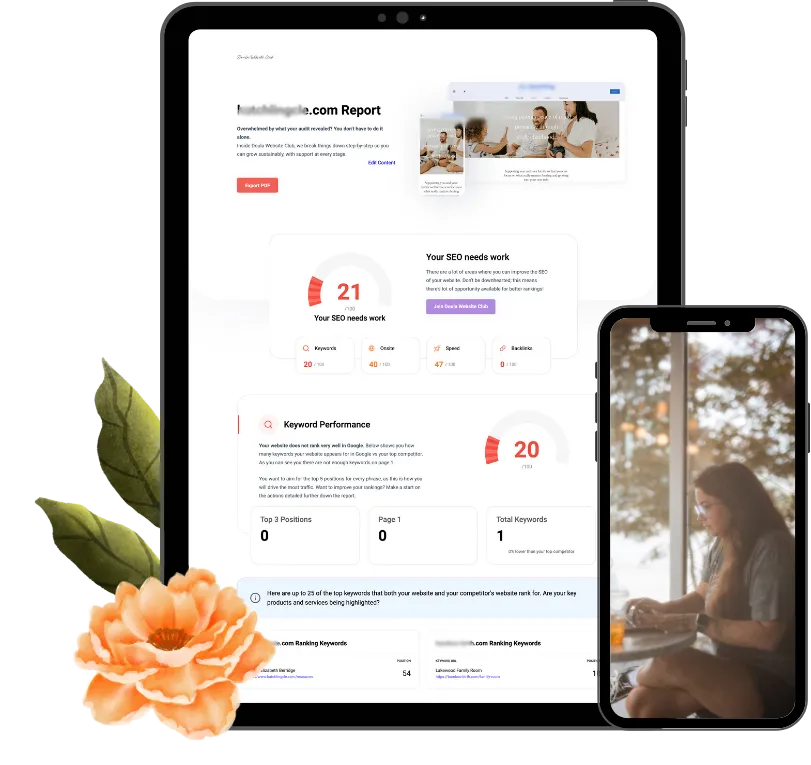
Want to see how your website is actually performing?
Look, I get it. Reading about what you should be doing and actually knowing where your site stands right now are two different things.
I created a free visibility report that shows you exactly what's working on your website and what's not. It takes about 2 minutes to fill out, and you'll get a personalized report that breaks down:
How visible you actually are in local search
What's helping (or hurting) your Google Business Profile
Which pages are doing the heavy lifting
Where the gaps are
No fluff. No overwhelming tech jargon. Just a clear picture of where you're at and what to prioritize first.
Get your free visibility report here
Your work deserves to be found. Not by shouting into the void. Not by becoming a content machine. But by being clear, present, and rooted exactly where you already are.
Because the families searching for you right now? They need to find you. And Google just needs a little help understanding how to make that connection.

**Affiliate Disclosure
We participate in affiliate programs for products and services we use and recommend. By clicking links on this site and making a purchase we may receive a commission paid for by the company at no additional cost to our readers and clients. Thank you for your support.